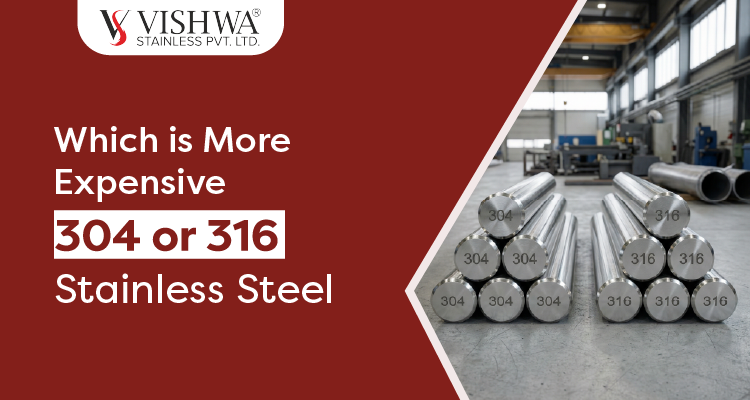
When sourcing stainless steel bars for industrial applications, one question comes up repeatedly: which costs more – 304 or 316 stainless steel? The short answer: 316 stainless steel is typically 10-30% more expensive than 304, depending on market conditions and material specifications. But understanding why this price difference exists – and when it’s worth paying extra, can save you thousands on your next procurement order.
At Vishwa Stainless Steel, we help engineering teams, procurement managers, and manufacturing companies navigate these material decisions every day. Whether you’re sourcing SS bright bars, precision stainless steel bars, or cold drawn stainless-steel bars, knowing the cost-performance trade-off between these two grades is essential for smart budgeting and long-term durability.
316 is More Expensive – Here’s Why
316 stainless steel costs more than 304 primarily because of its molybdenum content. This 2-3% molybdenum addition significantly improves corrosion resistance, especially against chlorides and marine environments—but it also increases raw material costs and manufacturing complexity.
Here’s the breakdown:
- 304 SS: Contains 18% chromium, 8% nickel (no molybdenum)
- 316 SS: Contains 16-18% chromium, 10-14% nickel, plus 2-3% molybdenum
That molybdenum makes 316 the go-to choice for harsh environments, but it comes with a premium price tag. For applications where standard corrosion resistance is sufficient, 304 delivers excellent value without the added cost.
What Makes 304 and 316 Different?
Both 304 and 316 are austenitic stainless steels—part of the 300 series family known for excellent formability, weldability, and corrosion resistance. But their chemical composition creates distinct performance characteristics.
304 stainless steel is the most widely used grade globally. It offers good corrosion resistance in normal atmospheric conditions and is easier to machine than many other stainless steels. It’s the default choice for indoor applications, food processing equipment, and architectural uses.
316 stainless steel takes corrosion resistance several steps further. The molybdenum addition creates a protective barrier against damage and crevice corrosion in chloride-rich environments. This makes it ideal for marine applications, coastal installations, pharmaceutical equipment, and chemical processing plants.
When you’re selecting stainless steel polished bars or hardened stainless steel bars, understanding these differences helps you avoid over-specifying (and overpaying) or under-specifying (and facing premature failure).
Why Does 316 Cost More Than 304?
The price premium for 316 stainless steel stems from four key factors:
1. Raw Material Costs
Molybdenum is an expensive alloying element. Global molybdenum prices fluctuate based on mining output and demand from the steel industry. When molybdenum prices spike, the gap between 304 and 316 widens.
2. Manufacturing Complexity
316 requires more careful processing during hot rolling and heat treatment. The additional alloy content affects how the material responds to forming, which can increase production time and quality control costs.
3. Supply Chain Economics
304 is produced in much higher volumes globally, creating economies of scale. Mills can produce 304 more efficiently, while 316 production runs are often smaller and more specialized.
4. Nickel Content Variations
316 contains slightly more nickel than 304, and nickel prices directly impact stainless steel costs. When nickel markets are volatile, both grades see price movement, but 316’s higher nickel content amplifies the effect.
For buyers sourcing SS bright round bars or SS bright hex bars, these factors mean 316 will consistently command a premium – but the extra cost often pays for itself in extended service life.
Price Comparison: Real Numbers You Can Expect
While exact pricing fluctuates based on market conditions, quantity, and specifications, here’s what industrial buyers typically encounter:
|
Material Grade |
Approximate Cost Range |
Price Difference |
|
304 Stainless Steel |
$3.50 – $5.00 per kg |
Baseline |
|
316 Stainless Steel |
$4.50 – $6.50 per kg |
10-30% higher than 304 |
|
316L (Low Carbon) |
$4.75 – $7.00 per kg |
15-35% higher than 304 |
These are general market indicators for raw material. Finished products like precision SS bright bars, peeled stainless steel bars, or piston rod quality bars will have additional processing costs that vary by diameter, finish, tolerance requirements, and order volume.
Bulk buyers and exporters working with industrial stainless-steel suppliers can often negotiate better rates, especially for consistent order volumes. The key is understanding that while 316 costs more upfront, its superior durability can reduce replacement frequency and lifecycle costs.
When Should You Choose 304 Over 316?
304 stainless steel is the smart choice when:
- Indoor Applications: Office buildings, commercial kitchens, interior architectural elements – anywhere moisture exposure is minimal, and chloride contact is rare.
- Cost-Sensitive Projects: When budget constraints are tight and the environment doesn’t justify premium corrosion resistance, 304 delivers excellent performance per dollar spent.
- Food Processing: Most dairy processing, beverage production, and food manufacturing equipment operate perfectly with 304. It meets FDA standards and handles typical wash-down environments well.
- Automotive Components: Interior trim, exhaust systems in normal climates, and structural parts that aren’t exposed to road salt often use 304 successfully.
- Standard Fabrication Work: For general machining projects using stainless steel rods for machinery or SS bars for engineering, 304’s machinability and weldability make it the preferred choice.
If you’re sourcing SS bright square bars for indoor fabrication or stainless-steel wires for general industrial use, 304 typically provides the best value proposition without compromising quality.
When is 316 Worth the Extra Cost?
Invest in 316 stainless steels when your application involves:
- Marine and Coastal Environments: Salt spray, brackish water, and ocean exposure demand 316 chloride resistance. Boat fittings, pier hardware, and offshore platforms require this grade as standard.
- Chemical Processing: Plants handling acids, salts, or corrosive chemicals benefit from 316 enhanced resistance to pitting and stress corrosion cracking.
- Pharmaceutical Manufacturing: The superior corrosion resistance and ease of sterilization make 316 (especially 316L) the industry standard for pharma equipment.
- Medical Devices: Implants, surgical instruments, and medical equipment often specify 316L for biocompatibility and corrosion resistance in body fluids.
- Coastal Construction: Buildings, bridges, and infrastructure within 5-10 miles of coastlines face constant salt exposure. Using 316 corrosion-resistant stainless steel prevents costly premature failure.
For procurement teams selecting stainless steel for aerospace applications or stainless steel for automotive components in harsh climates, the additional 20% investment in 316 can extend service life by 2-3x compared to 304.
How Does This Affect Your Product Selection?
Understanding the 304 vs 316 cost difference becomes practical when you’re actually ordering materials. Here’s how it impacts common product choices:
- For SS Bright Bars: Whether you need SS bright round bars, SS bright hex bars, or SS bright square bars, the grade selection affects both unit price and lead time. 304 bright bars typically ship faster due to higher inventory levels, while 316 may require custom production runs for specialized sizes.
- For Precision Applications: When ordering precision stainless steel bars or stainless-steel polished bars with tight tolerances (±0.01mm or better), the base material grade matters less than the finishing process. However, 316’s slightly different machinability characteristics can affect processing time and cost for ultra-precise work.
- For Specialized Bars: Products like stainless steel hardened bars, peeled stainless steel bars, or piston rod quality bars undergo additional processing. The grade of choice (304 vs 316) becomes one factor in a larger cost equation that includes heat treatment, peeling operations, and quality certification.
- For Wire Products: Stainless steel wires used in springs, cables, or mesh applications show similar price differentials. 316 wire costs more but delivers better performance in outdoor or corrosive environments.
Working with experienced stainless steel export suppliers like Vishwa Stainless Steel helps you navigate these choices based on your specific application requirements, not just price sheets.
Industry Applications: Where Price Meets Performance
Different industries have different cost ranges and performance requirements. Here’s where each grade typically makes sense:
- Oil & Gas: Predominantly 316 and higher grades. Sour gas environments, offshore platforms, and refinery equipment justify the cost premium. Stainless steel for fabrication in this sector often specifies 316 as minimum.
- Petrochemical & Chemical Processing: Mixed use—304 for non-critical components, 316 for process-critical equipment. The decision often comes down to specific chemical exposure and temperature ranges.
- Power Generation: 304 for cooling water systems in freshwater environments; 316 for coastal plants or seawater cooling applications.
- Pharmaceutical & Food Processing: 304 dominates food and dairy processing due to cost efficiency. Pharma leans heavily toward 316L for its superior cleaning properties and corrosion resistance.
- Automotive & Aerospace: 304 for interior components and standard applications; 316 for exhaust systems, fasteners, and parts facing road salt or jet fuel exposure.
- Marine & Offshore: Almost exclusively 316 and specialized marine grades. The hostile environment leaves no room for cost-cutting material quality.
- Infrastructure & Construction: Coastal and industrial zones use 316; inland projects typically specify 304 unless specific environmental factors require upgrading.
For manufacturing company owners and engineering and production heads, understanding these industry standards helps benchmark your material decisions against best practices in your sector.
Which One Should You Buy Your Project?
Making the right choice between 304 and 316 stainless steel comes down to three questions:
1. What’s Your Operating Environment?
High chloride exposure, salt spray, or corrosive chemicals? Choose 316. Controlled indoor conditions or minimal corrosive exposure? 304 works perfectly.
2. What’s Your Budget vs. Lifecycle Cost Calculation?
Can you afford 20-30% more upfront to potentially double service life? Run the numbers on replacement frequency, downtime, and maintenance costs. Sometimes 316 is actually cheaper over 10-15 years.
3. What Are Your Industry Standards?
Some sectors (marine, pharmaceutical) have established material specifications for good reason. Following industry norms often save you from costly trial-and-error.
For OEM buyers and fabricators and machining units, having both grades available in your supply chain provides flexibility to optimize each project independently.
At Vishwa Stainless Steel, we stock a full range of both 304 and 316 grades across our product lines—from SS Class-2 bars for general fabrication to stainless steel hardened bars for precision engineering. Our technical team helps you specify the right material grade, surface finish, and dimensional tolerances for your exact application.
Make the Right Choice for Your Application
The cost difference between 304 and 316 stainless steels isn’t absolute—it reflects real material and performance differences that matter for your project’s long-term success. While 316 consistently costs more, its superior corrosion resistance pays dividends in harsh environments where premature failure would be tragic.
For industrial procurement managers and export and bulk buyers, the key is matching material specifications to actual operating conditions. Over-specifying wastes budget; under-specifying risks of failure. Smart sourcing starts with understanding these trade-offs and partnering with suppliers who provide technical guidance, not just price quotes.
Vishwa Stainless Steel specializes in helping industrial buyers navigate these material decisions. Whether you need precision stainless steel bars, cold drawn stainless-steel bars, or stainless-steel wires for demanding applications, our technical team ensures you get the right grade, finish, and dimensions for your specific needs.
Ready to source the right stainless-steel grade for your project? Contact Vishwa Stainless Steel at vishwastainless.com for technical consultation, detailed quotations, and access to our complete range of stainless-steel bars, bright bars, and precision products. Our team helps you optimize material costs without compromising quality or performance.
Get expert material selection support today—your project deserves the right stainless-steel solution.
Frequently Asked Questions (FAQs)
1. Is 316 stainless steel always better than 304?
No. 316 offers superior corrosion resistance, especially against chlorides, but “better” depends on your application. For indoor use or non-corrosive environments, 304 provides excellent performance at lower cost. Choosing 316 when 304 suffices means paying extra without gaining practical benefits.
2. How much does 316 costs compared to 304 in bulk orders?
Bulk buyers typically see 10-20% price differences for standard forms. The gap narrows slightly with larger volumes but never disappears entirely due to the inherent molybdenum cost. High-quality SS bars suppliers often offer volume discounts that make 316 more accessible for large projects.
3. Can I substitute 304 for 316 to reduce costs?
Only if your application doesn’t require 316 enhanced corrosion resistance. Never substitute 304 for 316 in marine, coastal, chemical processing, or pharmaceutical applications. The short-term savings will be erased by premature failure and replacement costs. Consult with quality and materials engineers before downgrading specifications.
4. Which grade is better for machining and fabrication?
304 is slightly easier to machine due to lower nickel and no molybdenum content. It produces better surface finishes with less tool wear. However, the difference is marginal, and experienced fabricators and machining units work successfully with both grades. Your choice should prioritize corrosion requirements over machining convenience.
5. Do 304 and 316 prices fluctuate differently?
Yes. Both track nickel prices, but 316 also follows molybdenum market trends. This dual exposure can make 316 pricing more volatile. Working with reliable stainless steel manufacturing materials suppliers helps you navigate these market fluctuations with forward pricing and inventory management.